
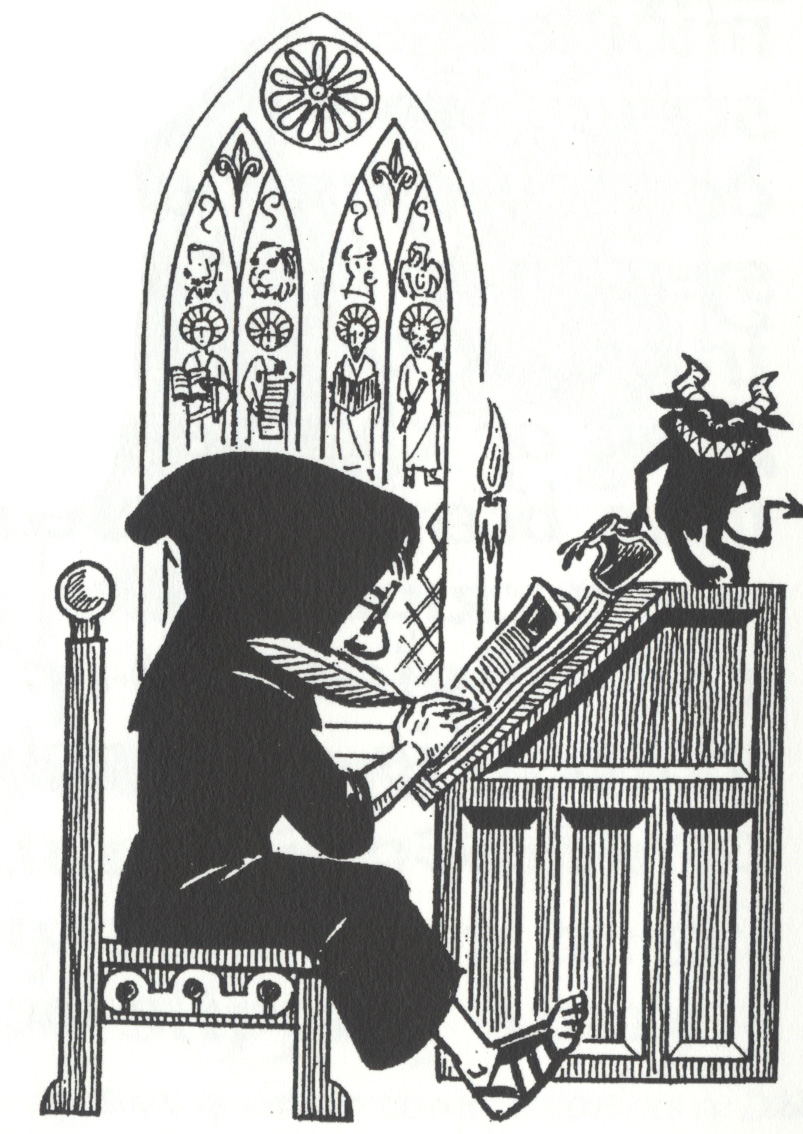
Medieval Cartooning
I just wrapped up a whirlwind convention season. CAKE, FLOP, MoCCA, etc. … and the International Congress of Medieval Studies in Kalamazoo. If you know my personal comic work, you’ll know that I’ve always had a strong interest in the Middle Ages, and more specifically in the transition from Medieval manuscript culture (chirographic) to print culture (typographic), and the various ways this media transition influenced civilizations (see “Comics As Technology of Consciousness” in Cartoon Dialectics #3).
I, along with Andy Hartzell, represented Uncivilized and comics in general to an audience of Medieval scholars from across the country and the world. We both gave talks on links between the Middle Ages and comics. Andy focused on Medieval Arcana in contemporary graphic novels. This interest was spawned by his own work on his Monday graphic novel. We’ll post a video of his presentation soon for all to see.
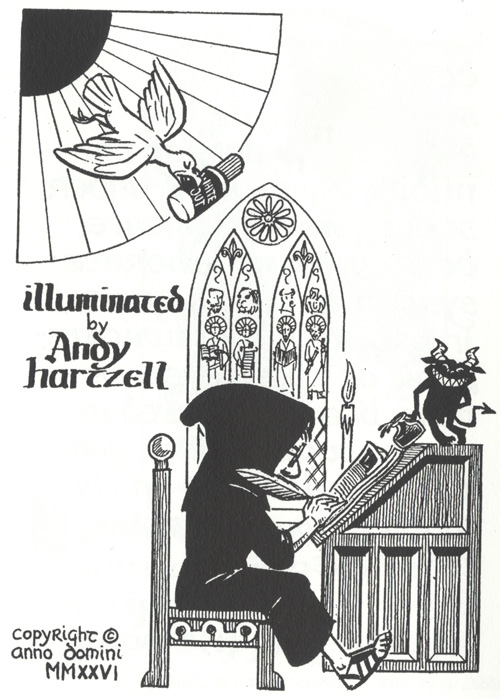
Medieval Mode in the Print Age
My presentation focused on the revival of the Medieval creative mode in the modern graphic novel. Briefly, Rodolphe Töpffer, the father of comics, was also a pioneer and innovator of a little-known Autography printing technique. Previously, to print an image, an artist had to redraw it on a woodcut or metal plate, or on a lithographic stone. Autography (invented by the father of lithography, Alois Senefelder) was the first method by which an artist (or cartoonist) could draw in situ (on paper) and reproduce the drawings by transfer. The golden age for Autography didn’t last long; it was soon replaced by photographic plates, but it created a direct route from drawing to print and, in a sense, smuggled the Medieval chirographic mode (handwriting and drawing, done directly on paper) into modernity.
The modern comic book, from its birth, is a kind of neo-medieval revival, albeit on a printed page. It’s resonant that the modern comic book emanates from that Romantic period that generated the new-medieval revival in art, architecture, and fiction. The content of Töpffer’s comics does not really engage with the neo-medieval movements, even if he does poke fun at some Romantic excesses of this time. But, when looked at at the level of the medium, consciously or not, Töpffer reinvents the Illuminated manuscript for the print era.
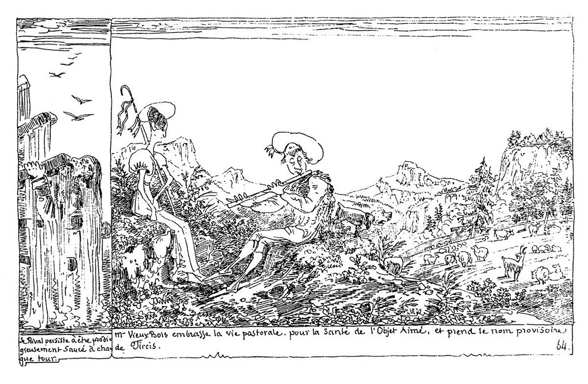
It’s often remarked that Goethe (the Romantic and Alchemist) saw great potential in Töpffer’s little comic books. He said: “If he [Töpffer] would pick out a less frivolous topic in the future and restrict himself a little [or ‘get his act more together’], he would produce things beyond all conception [or ‘invent things which would surpass all our expectations’].” In other words, Töpffer didn’t know he caught lightning in a bottle. Goethe saw the brilliance behind Töpffer’s modest lines on paper.
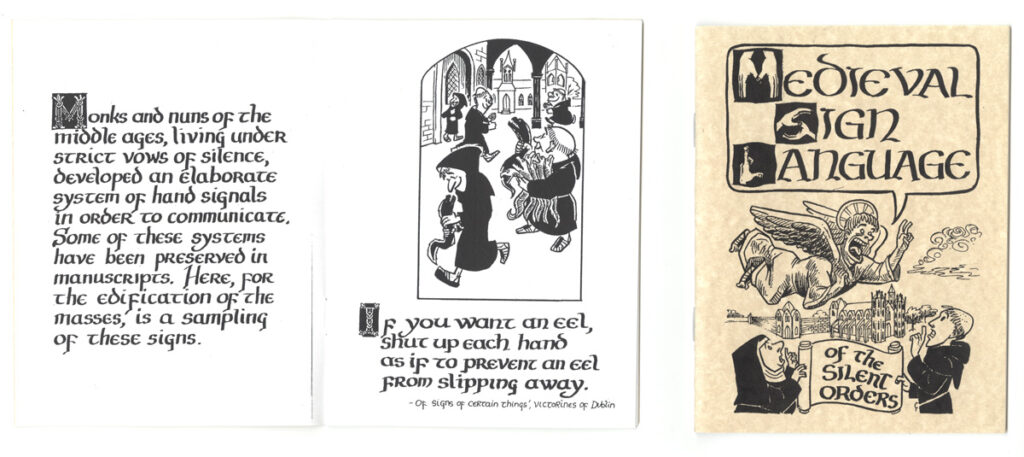
Medieval Sign Language of the Silent Orders
We also tabled a few comics with some (sometimes distant) connection to Medieval themes. I’m happy to report that Medieval scholars were very interested, and sales were brisk. Though we did get a few bemused faces. That’s to be expected 🙂 We produced a little mini-comic/zine for the event: it’s a new edition of Andy Hartzell’s comic about the Medieval Sign Language of the Silent Orders. It’s a wild little zine, beautifully hand-lettered and illuminated, with many nods to medieval techniques. Let us know if you’re interested; we might be able to make it more widely available! One way to get it now is to be a Patreon subscriber; a copy will be sent out soon!
This is only the tip of the Medieval iceberg. We’ll have more detailed write-ups, videos of the presentations, and a list of Uncivilized titles with Medieval themes. Stay tuned!
One thought on “Medieval Cartooning”