
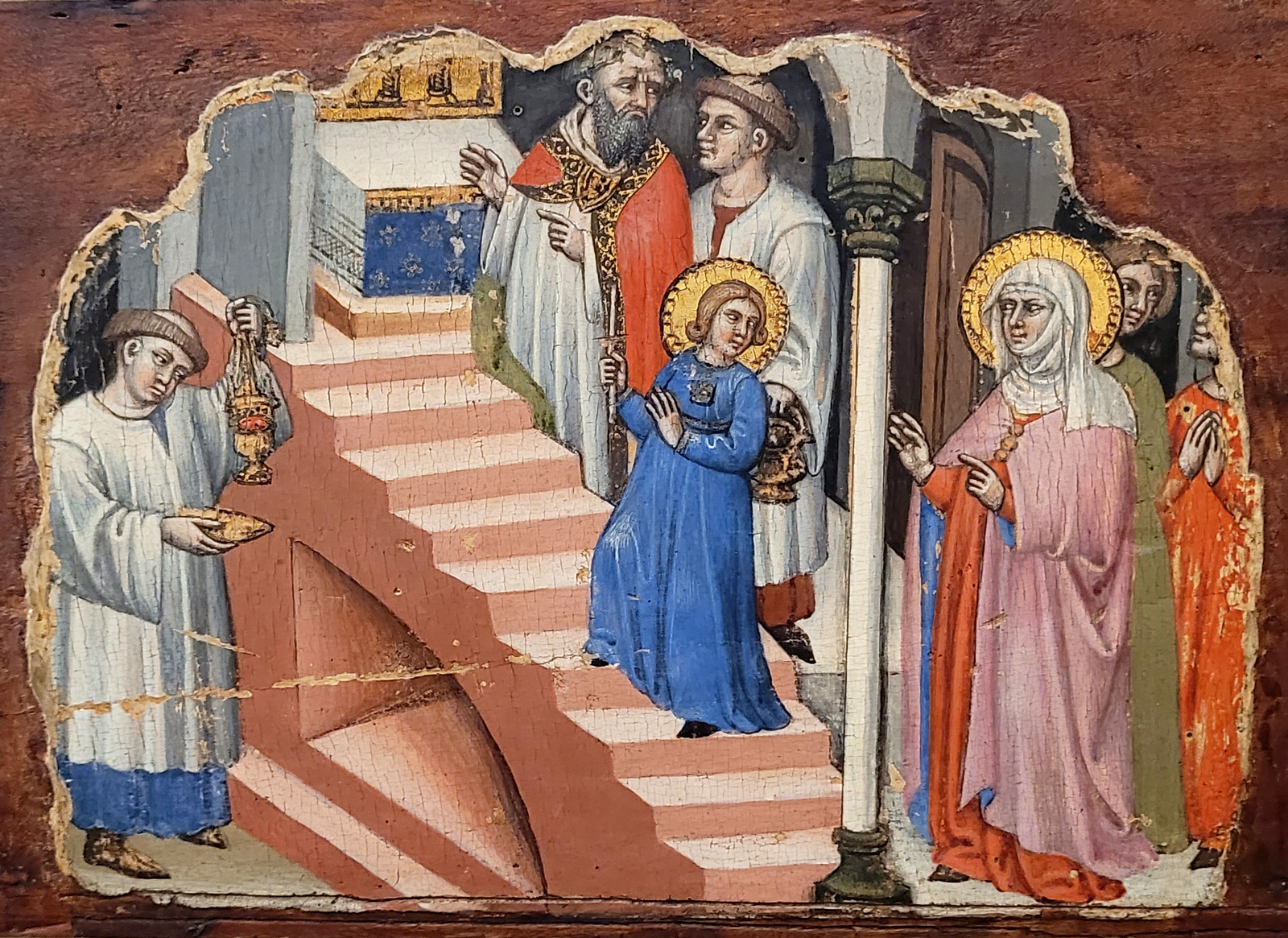
Medieval Mania: Searching For Ancient Comics in Italy
I spent the last couple of weeks in Italy (Rome, Bologna, and Milan) with my partner, who was attending a film festival. Since I wasn’t there for the festival, I had ample time to explore various museums, archives, and libraries and to look for traces of narrative art from Roman antiquity into the Italian Middle Ages. It allowed me to scratch the itch for Medieval art that had developed over the last few years, culminating in the Kalamazoo Medieval Congress earlier this year.
Ancient Tradition
From the outset, it became clear that there’s a sophisticated tradition of sequential storytelling alive and active for millennia on the Italian peninsula (elsewhere too, but for now I will confine myself mostly to what I saw in Italy). I don’t have a firm starting point here. This tradition dates back further, to the Greeks and Egyptians. Both cultures have their own traditions of sequential storytelling in sculpture, on temple walls, and in pottery, etc. But the Roman Empire conquered and absorbed both by 30 BC, and they influenced later Roman developments while continuing to develop locally.

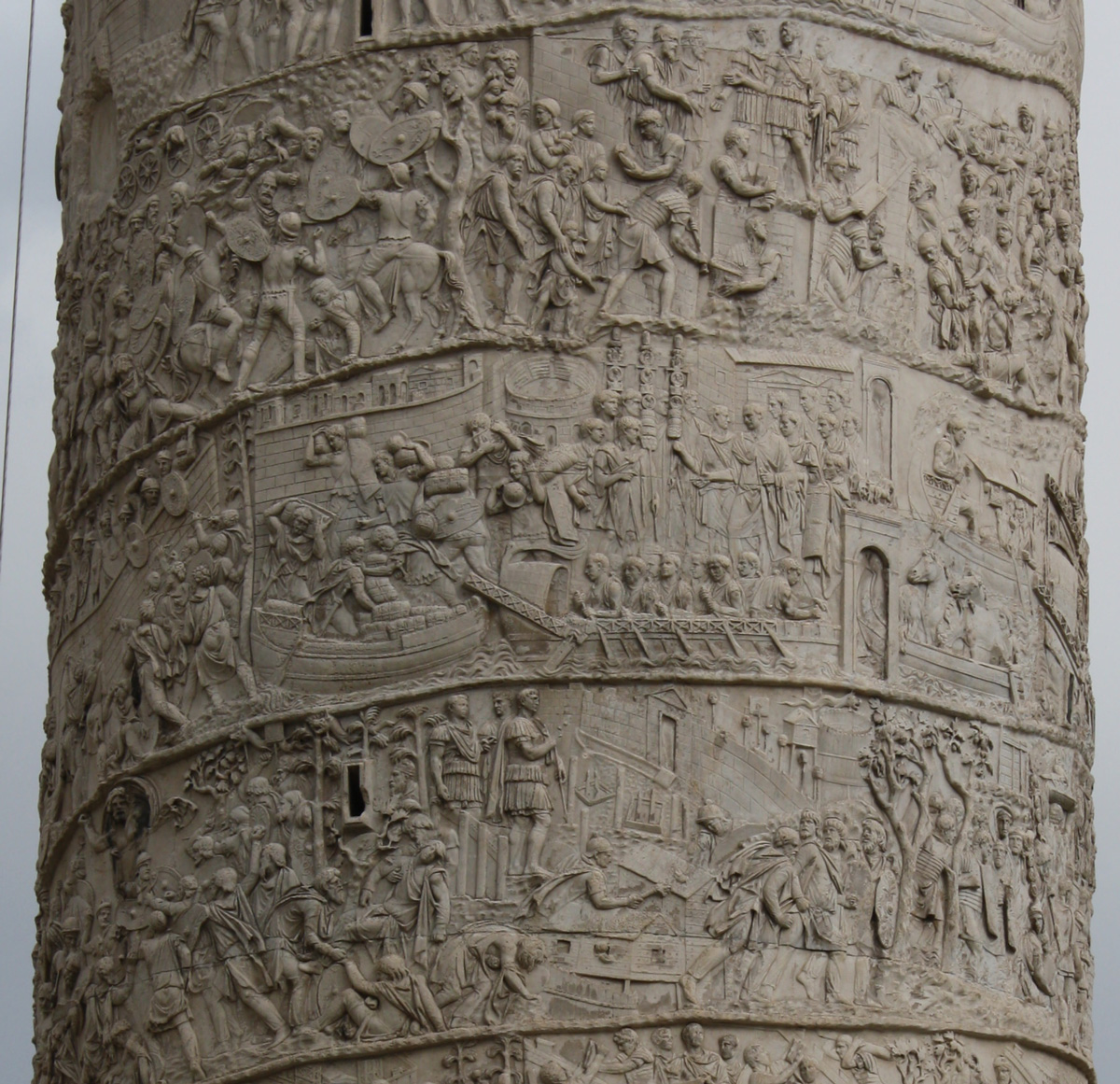
Trajan’s Column
During this time, visual narratives abound in Roman statuary, domestic and funerary frescoes, and mosaics. An obvious high point is Trajan’s Column (113 CE), prominently featured by Scott McCloud’s Understanding Comics and often mentioned in histories of narrative storytelling. It was a pilgrimage site for many artists, and its presence exerted a powerful influence for two millennia. Multiple copycat columns followed (Column of Theodosius I (393 CE), Bernward Column (Christ Column) (c. 1020 CE), etc.), and the narrative mode found its way into other contexts: narrative friezes, frescoes, etc.
Roman Church
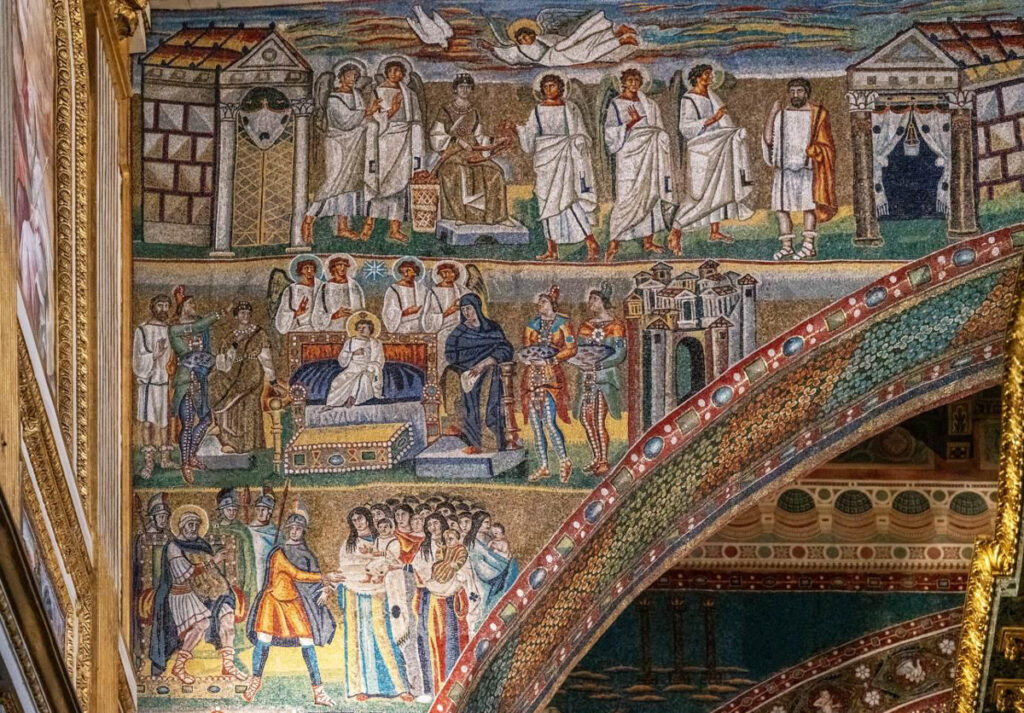
As Rome Christianized, the fast-growing Church absorbed much of its artistic output and used it for decoration, education, and propaganda. One early surviving example is the mosaics in Santa Maria Maggiore (5th Century CE, Rome). The mosaics tell various biblical stories. The images are not gridded as in later examples; instead, they are separated by architectural features such as columns.
Architectural Framing
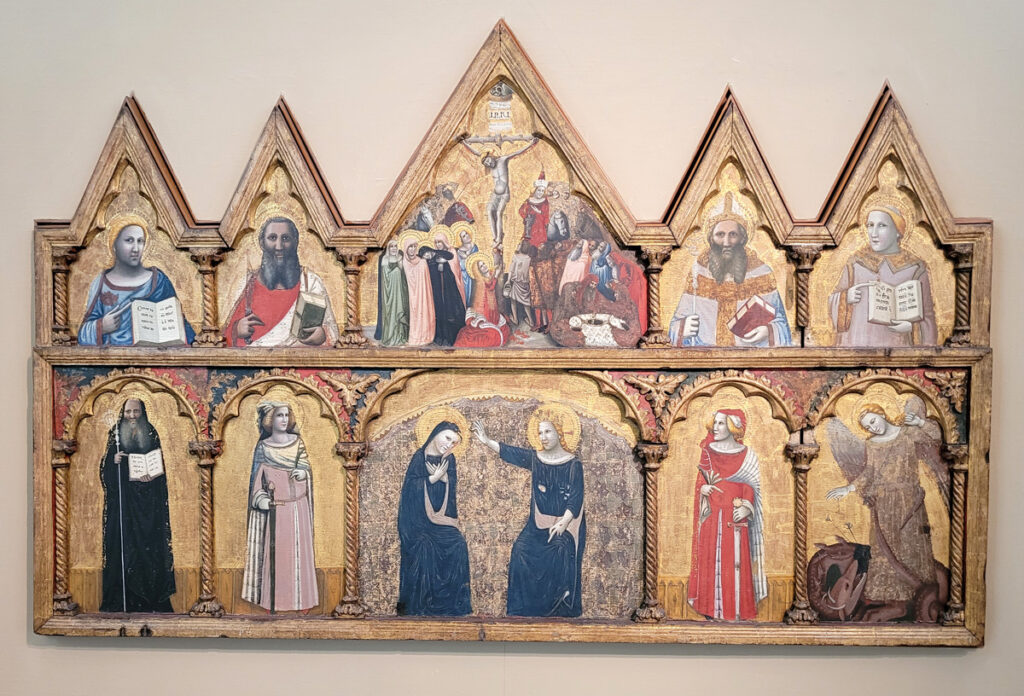
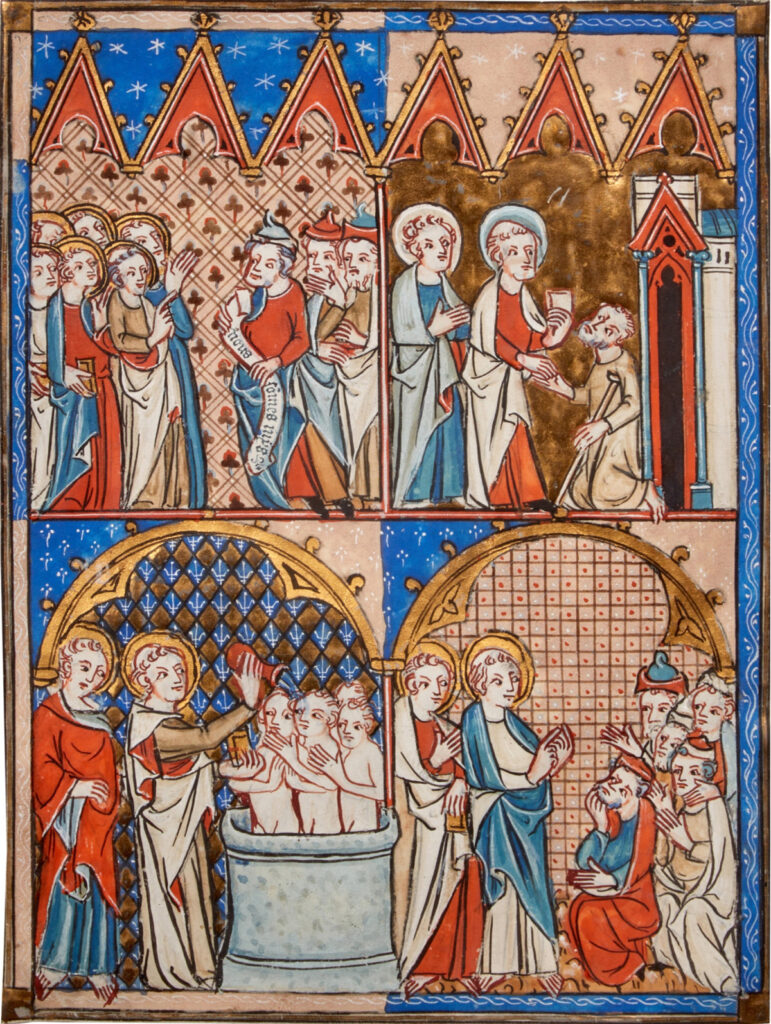
The role of architecture is underappreciated in the history of narrative art. Much of Medieval art in Rome, Bologna, and Milan was embedded into an architectural framework. Faux cathedral or church-like frames with multiple trompe-l’oeil pseudo-niches would contain paintings and sculpture arranged according to hierarchical or sequential logic. Most of these pieces were created to seamlessly integrate into a specific architectural space. But even when removed from the original context, architecture continues to serve as the structuring logic. The modern picture frame directly evolves from this tradition.
This architectural framing logic extends to other media, such as illuminated manuscripts. These were clearly never intended to be displayed on the wall. Nonetheless, they used architectural features, drawn or painted, to frame single images or distinguish separate narrative frames.
Giotto at Scrovegni Chapel
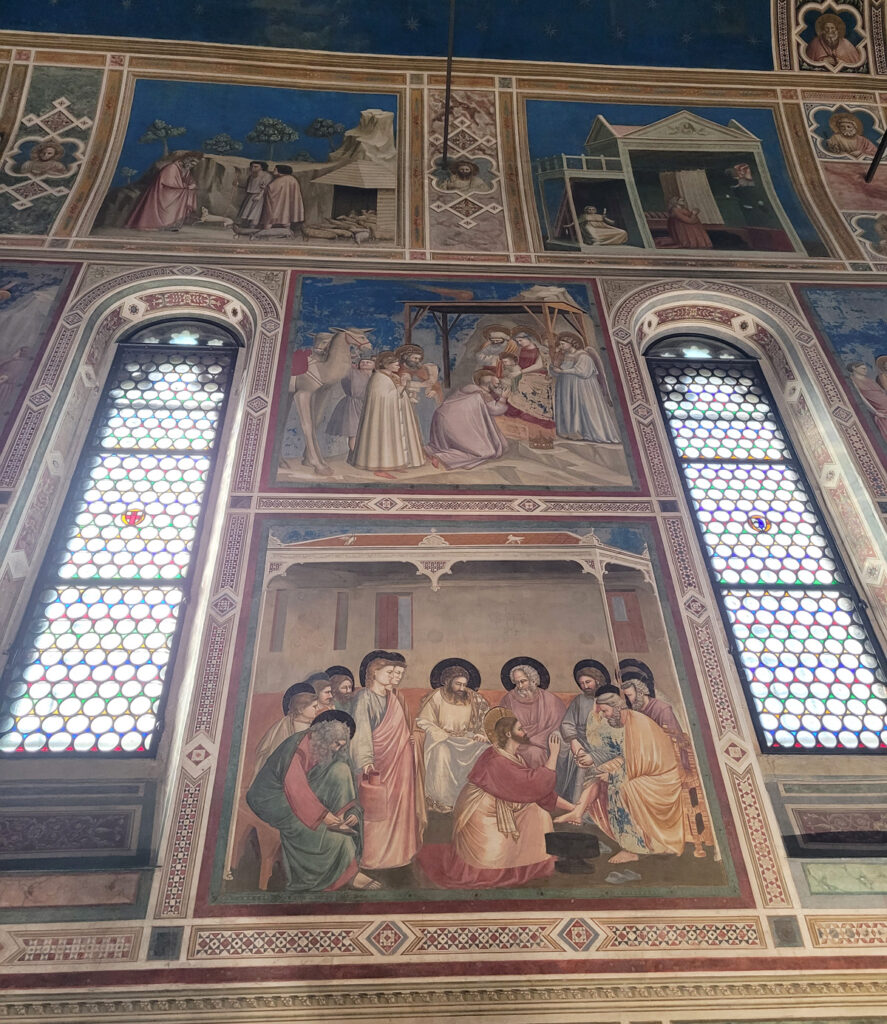
The most remarkable artifacts I visited or learned about were Giotto’s frescoes in the Scrovegni Chapel (completed 1305 CE) and the Bibbia Istoriata Padovana (1330-1340 CE) manuscript. I was dimly aware of Giotto, mostly for his pivotal role in the transition from the Middle Ages to the Renaissance. I never knew how narrative his work in the Scrovegni Chapel was. I took a day trip to Padua to see the Chapel, and I was not disappointed.
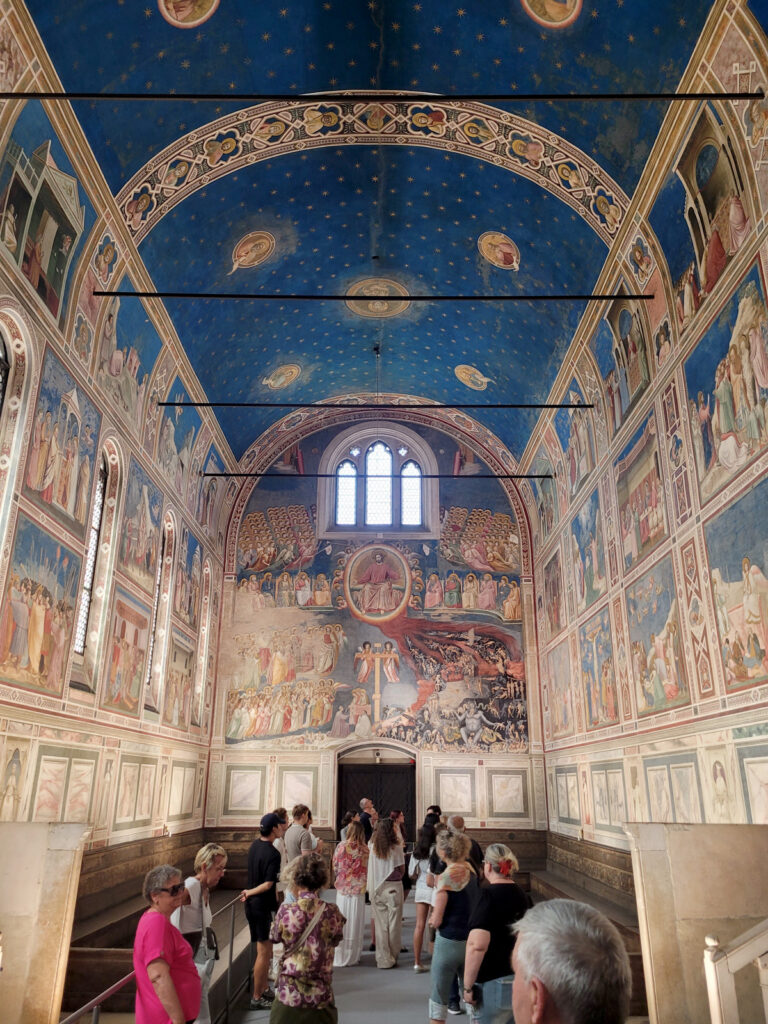
The chapel is painted, floor-to-ceiling, with three narrative stories, each confined to its own ‘tier’: the apocryphal story of Joachim and Ann, stories of Mary, and stories of Christ. Each frame is separated by either a painted architectural feature or a real one, such as a window. Giotto uses many features still used in contemporary comics to help the viewer follow the story from frame to frame. Figures are of similar size, and the main characters have distinct designs or colors that continue through the narrative. He also uses simplified background features, natural or architectural, to additionally help frame the focus of each panel. It was a remarkable place that allowed you to inhabit the story by walking and ‘reading’ as you went. The visit was much too short. Access is throttled into short 15-minute visits. Longer ones are possible through tours. If you have a chance, try to go for a longer one.
Bibbia Istoriata
The other artifact I didn’t see in person. The exhibit I wanted to see (at the Diocese Museum in Padua) had been taken down just days before I got there. It was supposed to feature the Bibbia Istoriata Padovana (Paduan Illustrated/Historiated Bible). This is a fully illustrated Bible, presented in sequential images, created in Padua just a couple of decades after Giotto completed the chapel. In fact, the bible was directly influenced by Giotto’s work in the chapel and directly adapts his narrative clarity, naturalism, and architectural framing devices. It is a remarkable document. Each page is structured by visual panels (typically, though not always, 4-panel pages), each with short captions with Biblical text adapted for this purpose. It looks a lot like a comic book.
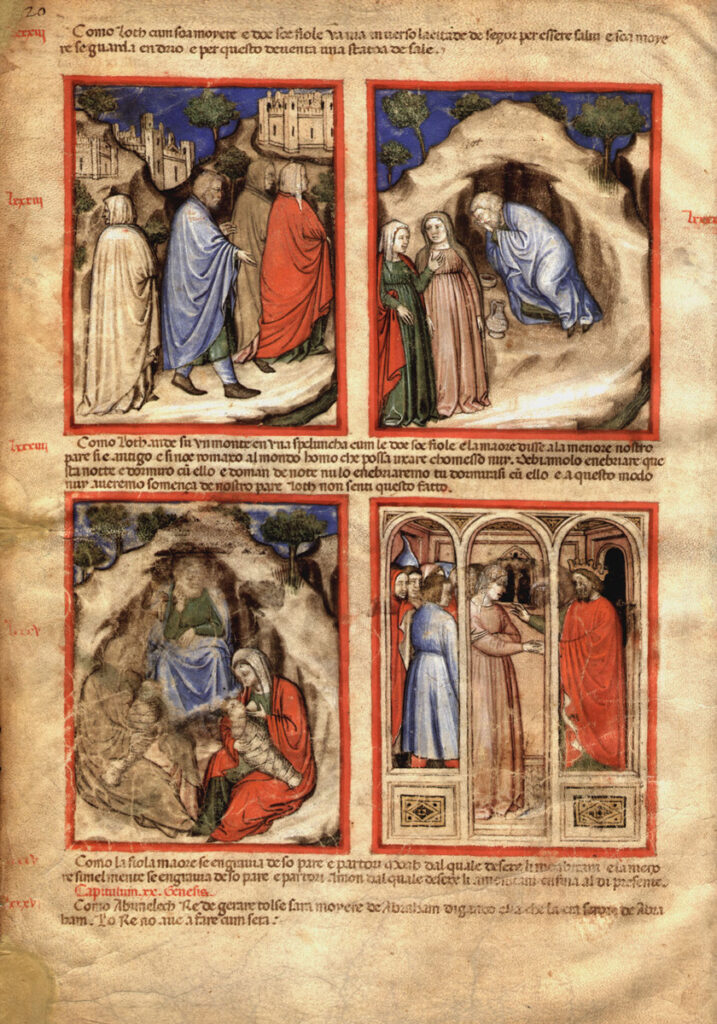
The Bible currently exists in two parts: one in the British Library and the other in the Biblioteca dell’Accademia dei Concordi, Rovigo. Other parts are lost. The two surviving parts were briefly reunited at an exhibition in Padua. Alas! I missed it by a few days! Scans do exist online and in library archives.
Visual Education
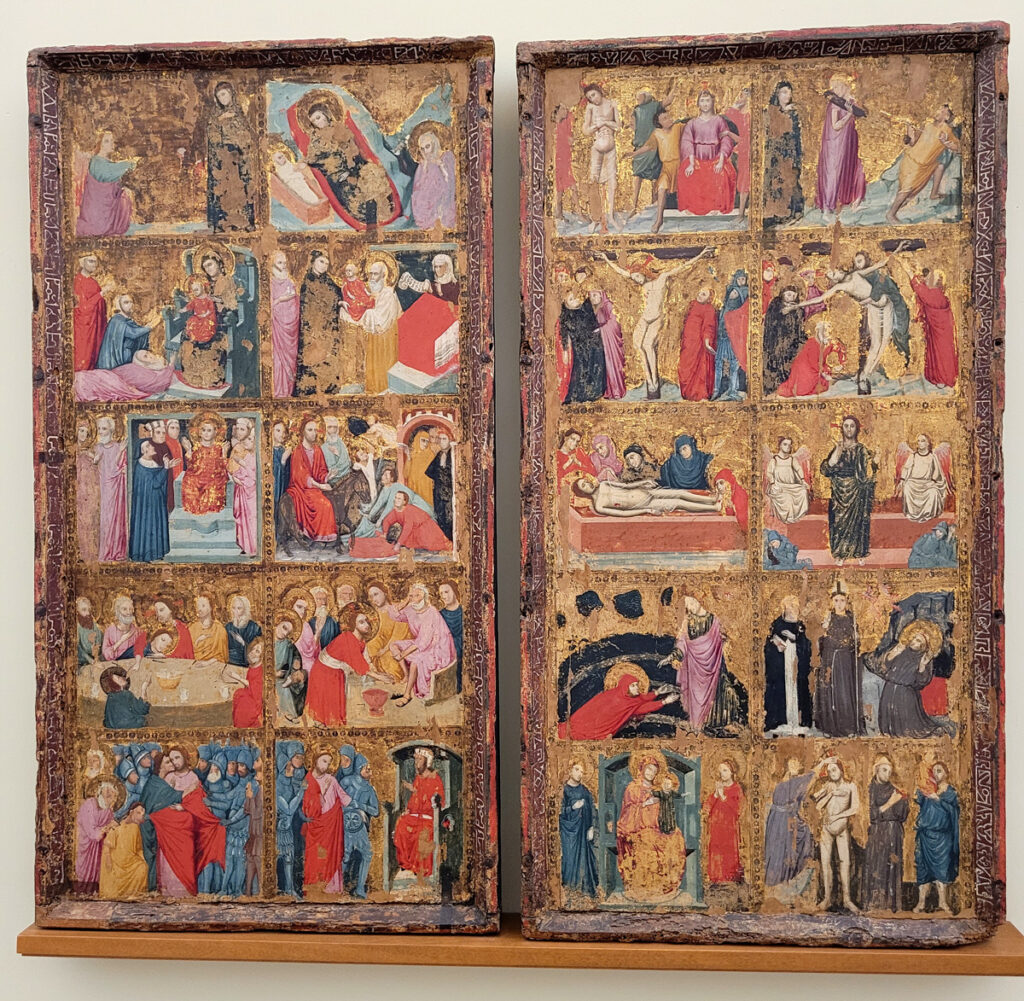
None of this is to say that a kind of “comic book” culture existed in Medieval Italy or in Europe more broadly. But there is a long tradition of visual storytelling in Europe dating back at least to late Roman Antiquity. That tradition was absorbed, adapted, and spread by the Catholic Church throughout Europe.
Joseph Henrich describes something similar in his WEIRD book. He traces the diffusion of certain cultural packages by the Church (e.g., prohibitions on cousin marriage, literacy, monasticism) that helped shape modern European culture. Henrich doesn’t get into the visual stuff specifically, but the Church had a massive visual propaganda/education program that was directly incorporated into its architectural, religious, and artistic program. It was designed to educate the illiterate masses in Christian stories and dogmas. This is collectively known as Biblia pauperum, or the poor man’s Bible. It makes sense that this program followed the Christian diffusion routes detailed by Henrich, thereby spreading the Biblia pauperum cultural package. How much does this history constitute a kind of cultural dark matter that underlies Western visual culture and influences various cultural developments?
Comics Culture
I’m going to get a little speculative here. Is it possible that this millennia-long ‘visual education’ program ultimately affected the development and popularity of comics in Europe? Today, the countries with the biggest comics industries in Europe tend to be traditionally Catholic (even if they are broadly secular today, they are countries where Protestantism never became a majority culturally). France, Belgium, Italy, Spain, and Poland are places where comics are widely held in high esteem, and their comic industries are more established than in other parts of Europe. Of course, comics have spread throughout Europe with significant scenes in most countries, but they are not as culturally dominant as in the above-mentioned places. This is a broad observation that warrants closer examination.
It was an eye-opening trip that will take some time to digest fully. I wanted to get these general impressions down before I forget them. Reach out if you have any comments or interesting ideas to add.